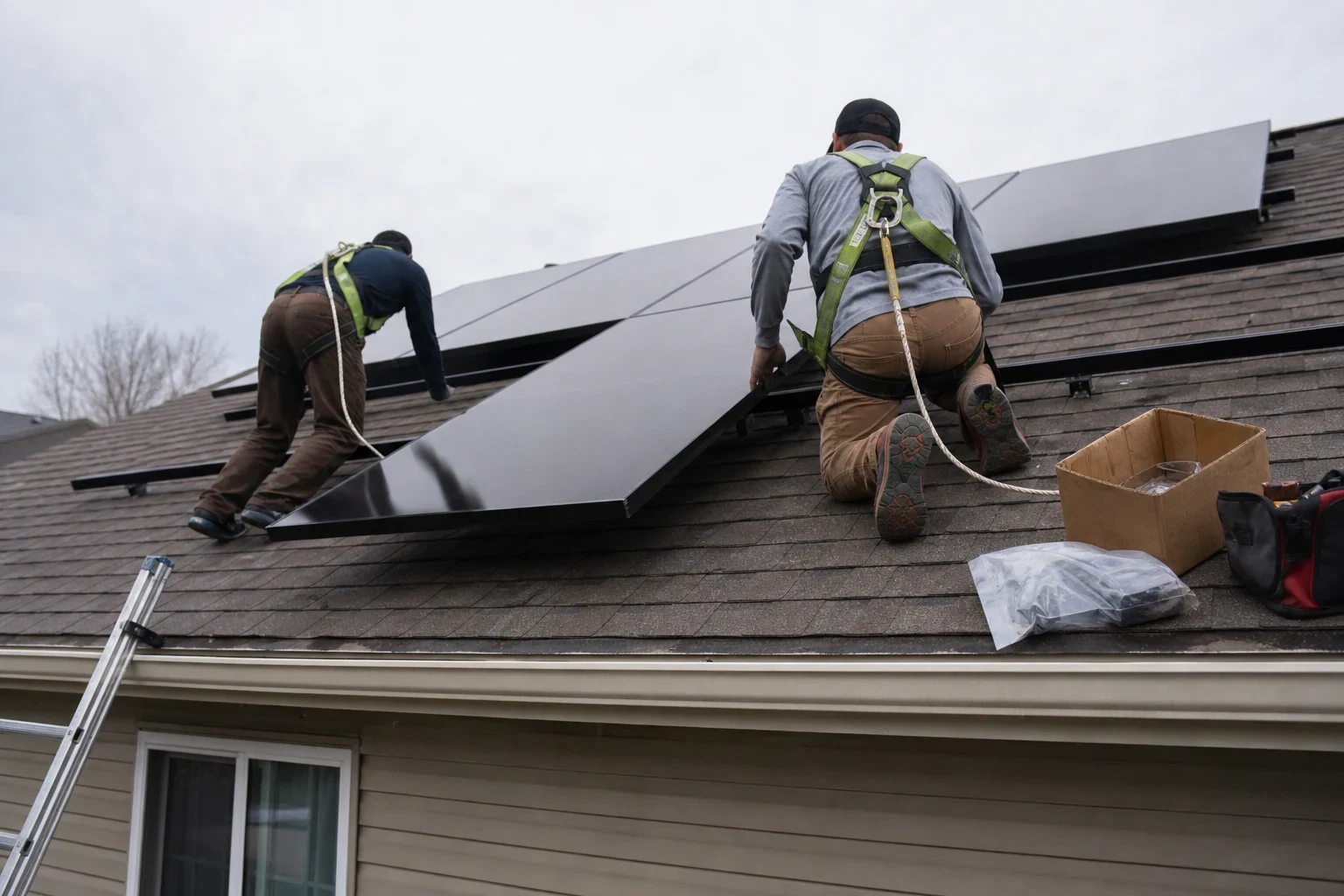
ServicesSolar Panel Repair
Solar Panel Repair in Kaysville
When your monitoring shows a drop, something specific has failed: an inverter, a connector, a cell, a breaker. We trace the loss to the part that caused it, repair or replace that part, and leave the healthy equipment alone so your system keeps producing for years.
Repair That Fixes the Cause and Protects the Rest
A solar array is a chain of parts in series. Modules feed strings, strings feed an inverter or a set of microinverters, and the inverter feeds your main panel through a disconnect and breaker. One weak link pulls down everything behind it, so a single corroded MC4 connector can cut the output of a whole string.
Our approach is upkeep, not replacement by default. We start with your monitoring data, test at the component level, and tell you plainly whether a part can be repaired or needs to be swapped. Fixing a loose termination today keeps it from heating, arcing and damaging a module or an inverter later.
We are licensed in all states served, and we work on systems throughout Kaysville and nearby towns like Layton, Farmington and Centerville.
What Our Solar Panel Repair Covers
Inverter diagnostics
We read fault codes on string inverters and microinverters, check DC input voltage against the expected string voltage, and confirm the unit is not tripping on grid or ground faults. Many inverter faults trace back to wiring rather than the inverter itself.
Connector and wiring repair
MC4 connectors that were not fully crimped or have taken on moisture build resistance and heat. We replace them with matched connectors, re-secure loose conductors and check conduit runs for chafing.
Module testing and replacement
We look for cracked glass, browned cells, delaminating backsheets and hot spots from failed bypass diodes. A module that is dragging down its string gets replaced with a compatible part.
Monitoring restoration
A dropped Wi-Fi link or failed gateway makes a working system look dead. We reconnect monitoring so you can see production again and catch the next problem early.
Grounding and disconnect checks
We verify equipment grounding, rapid shutdown function and the AC disconnect and breaker, since a weak ground or a worn breaker can cause nuisance trips.
Signs Your System Needs Repair
Production dropped and stayed down
Line up your output against the same season a year ago. If sunny days now produce noticeably less and the gap does not close, a string, module or microinverter has likely failed. Weather alone does not cause a lasting dip.
Inverter shows a fault light
A red or amber light, or an error code on the display, means the inverter has shut down or limited output. Write down the code before you call; it narrows the cause.
Monitoring shows zero for one panel or string
With microinverters, one tile reading zero usually means a single unit or its connector has failed. On a string system, a whole string at zero suggests an open circuit.
Visible damage after a storm
Hail, wind-blown debris and the freeze-thaw swings common along the Wasatch Front can crack glass or loosen wiring. Cracks let moisture reach the cells, so they are worth addressing before the next winter.
Breaker keeps tripping
Repeated trips on the solar breaker point to a ground fault, a worn breaker or an inverter problem. Leave it off and have it checked.
How a Repair Visit Runs
- 1
Free virtual appointment
We start with a call and a look at your monitoring data, inverter codes and any photos you can take. Often this narrows the problem to one or two likely parts before anyone drives over.
- 2
On-site testing
At your home we safely shut the system down, then test string voltage, insulation resistance and individual components. We take photos of what we find so you see the same thing we do.
- 3
Clear repair-or-replace answer
You get a written, line-item estimate that names the failed part, explains why it failed and separates what needs fixing now from what can wait.
- 4
Repair and verification
We complete the repair, restart the system and confirm output on the inverter and in your monitoring. We clean up our materials before we leave.
What Moves the Cost of a Repair
Repair pricing depends on which part failed and how much work it takes to reach it. We quote after diagnosis so the number matches the actual fault, and we list each part and labor item separately.
- Which component failed
- A connector or a breaker is a small part. An inverter or a module costs more, and microinverters, string inverters and module models vary in price.
- Part availability
- Older modules and discontinued inverters may need a compatible substitute. Matching electrical specs on a replacement takes extra care.
- Access to the equipment
- How easily we can reach the failed module, wiring run or inverter affects labor time.
- Warranty status
- If the failed part is still under a manufacturer warranty, the part cost may be covered and the job becomes mostly labor and paperwork.
- Related damage
- A connector that overheated may have scorched the module lead next to it. We check adjacent parts so one repair does not leave a second failure behind.
Questions About Fixing a Solar System
Something not covered here? (801) 928-7645
My system was put in by a different installer. Will you work on it?
We will. Who mounted the panels does not change how we test them, so we take on systems from any original installer. Before the visit, send us the model numbers printed on the inverter and on a module label, and we will line up parts that match the electrical specs.
Will a warranty pay for my repair?
It comes down to who supplied the equipment and what that manufacturer's terms cover. Solar and battery products we install on a home carry a 25-year warranty. On equipment from another company, we name the part that failed and its maker so you can find out what coverage still applies.
Is an older system worth fixing, or should it be replaced?
Modules lose a sliver of output each year, yet most keep producing for decades. When the panels test healthy and the fault sits in an inverter or a wiring run, fixing that one piece is usually the better use of your money. If our readings say replacement makes more sense, we tell you that directly.
Can I keep running a system that is showing a fault?
Turn it off at the AC disconnect and keep it off if the breaker trips again and again, you notice a burning smell or you spot scorched wiring. A monitoring outage by itself poses no safety risk, though it can mask a real drop in production.
Could I add a battery during the same project?
In many cases, yes. After the array is back to healthy output, we can go over battery storage or other solar system add-ons during the same discussion.
Get Your System Producing Again
Tell us what your monitoring shows and what the inverter is displaying. We will walk you through the likely cause and the next step on a free virtual appointment.