How Much Battery Storage Do I Need to Power My Home in Kaysville?
The right battery size comes from two numbers on your own panel and bills, not from a rule of thumb.
How much battery storage do I need to power my home?
You need enough usable kilowatt-hours to run your chosen loads for as long as you want to ride out an outage. You also need enough kilowatts of output to start your largest motor. For most homes that means sizing for critical circuits first, then adding capacity for longer outages or heavier appliances. Talk it through at (801) 928-7645.
Should you back up the whole house or only critical loads?
This choice sets the size more than anything else. A critical loads setup moves a handful of circuits onto a separate subpanel that the battery feeds during an outage. Those are usually the refrigerator, furnace blower, a few lighting circuits, internet and the kitchen outlets. Everything else goes dark until the grid returns.
Whole-home backup puts the battery and its transfer equipment ahead of your main panel, so every breaker stays live. That is more convenient, but it also means the battery will try to run the dryer, the range and the central air if someone switches them on. To handle that, you need more stored energy and more output power, or load management that sheds big appliances automatically.
Many homeowners land in the middle: whole-home wiring with smart breakers or load controllers that keep the electric water heater or EV charger off while the system is islanded. We cover those controllers on our solar system add-ons page.
Power and energy are two separate limits
Battery specs list two figures, and people often mix them up. Kilowatt-hours (kWh) describe how much energy is stored, which decides how long the lights stay on. Kilowatts (kW) describe how much the battery and inverter can deliver at one instant, which decides what can run at the same time.
A battery can have plenty of kWh and still trip offline when a well pump or air conditioner compressor kicks on, because motors pull a surge of current for a fraction of a second at startup. That locked-rotor current can be several times the motor's running draw. Sizing has to clear both limits.
- Energy check: add up watts times hours for each load. A 500-watt load running 6 hours uses 3 kWh.
- Continuous power check: add the running watts of everything that may be on together and compare it to the inverter's continuous kW rating.
- Surge check: compare the startup current of your largest motor to the battery's peak or surge rating.
- Usable capacity: use the battery's usable kWh, not the total cell capacity, since some is held back to protect the cells.
How long do you want to run without the grid?
Outage length is the second big driver. A battery sized to carry critical loads overnight is a very different system from one meant to carry a home for several days. Strong canyon winds along the Wasatch Front and winter storms are the usual reasons people ask us about longer runtimes.
Recharging matters as much as storage. With solar panels connected, the battery refills during the day, so a modest bank can cycle through a multi-day outage in summer. In December the days are short and snow can cover the array, so daily solar harvest drops. If winter backup is your main concern, we size the battery to bridge at least one low-production day rather than assuming the panels will refill it by afternoon.
Your heating fuel changes the math too. A gas furnace only needs its blower motor and controls on backup, which is a small load. An all-electric heat pump draws far more, and its compressor brings its own startup surge.
Sizing so the battery lasts
A battery that is too small for its job wears faster. Lithium cells age with every charge cycle, and repeated discharges to the bottom of their range age them faster than shallow ones. When a system is sized with some headroom, a normal night uses only part of the capacity, and the cells see gentler cycles over their life.
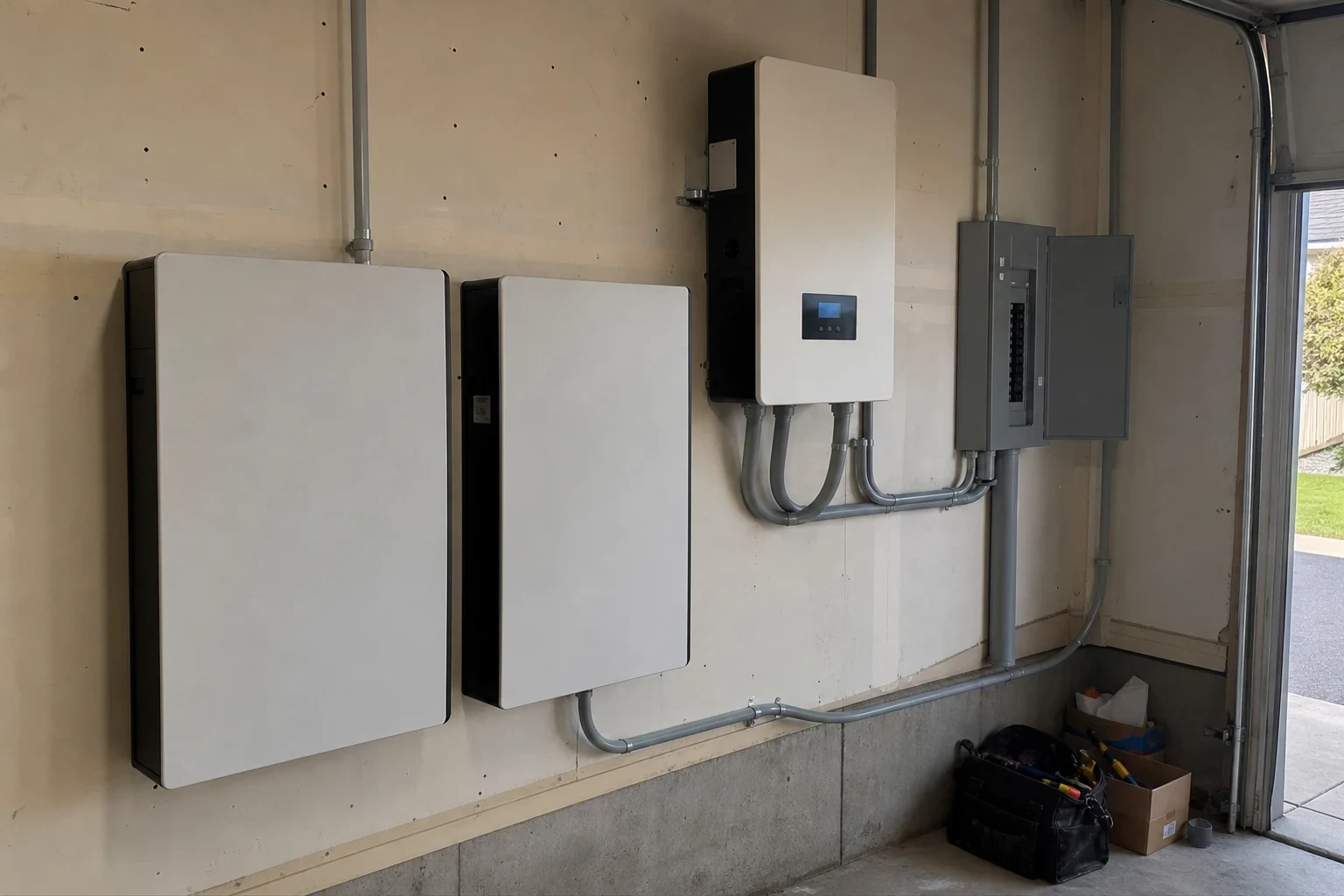
Temperature is the other factor. Most home batteries use lithium iron phosphate chemistry, which tolerates heat well but limits charging below freezing. Many units have internal heaters, but they spend stored energy to keep the cells warm. We look at where the battery will mount, often an attached garage wall or a shaded exterior wall, and keep it out of direct afternoon sun and away from spots that drop well below freezing.
Two settings also protect the bank over time. The backup reserve keeps a set percentage untouched for outages, so daily self-consumption never drains it flat. Firmware updates from the manufacturer adjust charging behavior, so we make sure monitoring stays connected after the job is finished.
How we work out your number
We start with a free virtual appointment. You share recent utility bills or your usage history, and we walk through your electrical panel with you on video to see which circuits matter and what motors are on them.
From there we build a load list with running watts, startup surge and expected hours, then compare it against battery and inverter ratings. If you already have solar, we check the existing inverter to see whether the battery can couple on the AC side or needs a hybrid inverter. You get a written recommendation that shows the kWh and kW targets and why we chose them, so you can see which loads push the size up and decide what is worth backing up.
- Pull 12 months of usage to catch winter and summer peaks
- List critical circuits and the largest motor loads
- Set a target outage length for summer and winter
- Match usable kWh, continuous kW and surge rating to that list
- Plan the mounting spot for temperature and clearance
Battery sizing questions
Something not covered here? (801) 928-7645
Can I add a battery to the solar system I already have?
Usually, yes. Depending on your current inverter, we either add an AC-coupled battery with its own inverter or swap to a hybrid inverter that manages both panels and storage.
Can I start small and add capacity later?
Many battery systems are modular, so extra units can be stacked onto the same inverter later. We plan the wiring and wall space for that at the start, so expanding does not mean redoing the install.
Do I need solar panels to have a battery?
A battery can charge from the grid and cover a short outage on its own. Without solar, though, it cannot refill during a longer outage, so most homeowners pair storage with solar panel installation.
Will a battery run my central air conditioner?
It can if the inverter's surge rating covers the compressor's startup current and there is enough stored energy for the runtime you want. A soft-start kit on the compressor lowers that surge and often makes the difference.
Get your battery size worked out
In a free virtual appointment we look at your bills and your panel with you, list the loads you want covered, and give you a clear kWh and kW target for your home.